
“Temporismo”
The Artistic Style of Gloria V Fenaroli
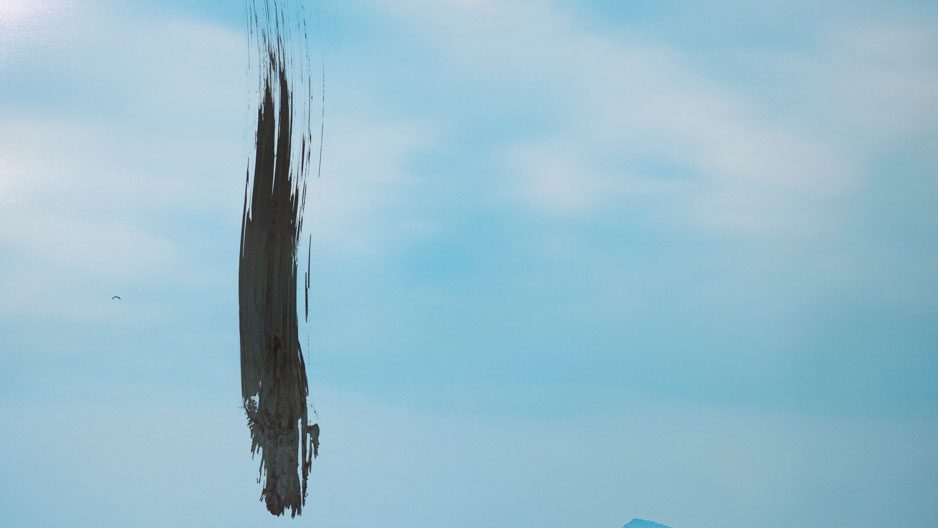
Gloria V Fenaroli’s work is born from a radical vision of time as a creative material.
Her technique, defined as Temporism, does not merely combine photography and painting: it crosses them, transforms them, generating a unique language that acts on the temporal perception of the work.
At the foundation of Temporism lies an essential gesture: a pictorial sign, inspired by Japanese calligraphy, that intervenes on the photographic image as a ritual act. This stroke, suspended between writing and breath, does not complete the image but reopens it to the present. It alters its nature: no longer a document of what has been, but a threshold toward what still lives.
Photography, traditionally bound to memory and to the past, is here unanchored from its fixity. The sign does not decorate, does not overlap. It activates. It introduces into the image a temporal fissure that allows the inner time of the artist to manifest and the observer to traverse it.
This practice is not aesthetic, but existential. Each stroke arises from a condition of listening, slowness, presence. It is a ritual action, tied to a feminine idea of time: not linear, but circular, sensitive, fluid. The sign is the outcome of a body that inhabits time, that feels it and impresses it.
In Temporism, Gloria V Fenaroli does not represent time, she generates it. Her works do not illustrate an instant: they make it happen. Time becomes artistic matter, living presence, energy to be crossed. The image is not only to be looked at, but to be perceived, to be lived.
This technique shapes a visual and sensorial experience that moves between gesture and vision, between sign and silence, between light and threshold.
Temporism is, ultimately, a language of time: another time, intimate, traversable.